
Criminal Court Records in Jasper County
A criminal court record is the case file a court keeps after charges are filed against a person. It begins when a charging document reaches the clerk, and it grows with every filing that follows. The Circuit Clerk holds the criminal files for felony cases in Jasper County, sorted by judicial district. Inside the file sit the indictment or charging paper, bond orders, arraignment entries, plea petitions, motions, hearing notices, verdicts, and sentencing orders. The record is the official memory of the case. It is broader than an arrest entry, which only logs the moment a person was booked. For the narrower charge data, see the arrest and charge records page.
Felony cases reach Circuit Court after a grand jury indictment or a bind-over from a lower court. Jasper County sits in the Thirteenth Circuit Court District, which also covers Smith, Simpson, and Covington counties. District Attorney Chris D. Hennis prosecutes felonies for the district before the grand jury and at trial. Misdemeanors, traffic matters, and felony preliminaries start in Justice Court or a city court, and an appeal can later move a case up into Circuit Court. Two courthouses serve the county, one in Paulding for the First Judicial District and one in Bay Springs for the Second, so the first step is always to learn which district owns the file.
How a Jasper County Criminal Case Moves
A criminal case travels through clear stages, and each stage leaves a mark in the record. The docket reads as a timeline. You can follow it from the first filing to the last order, which is how readers tell a pending case from a closed one.
Case flow: Charges Filed › Arraignment › Pretrial / Motions › Plea or Trial › Disposition › Sentencing
Charges open the file. For a felony, that means an indictment returned by a grand jury or a bind-over order from Justice Court. At arraignment the judge reads the charges, the defendant enters a plea, and the court sets bond. Pretrial work fills the middle of the file with motions, discovery, continuances, and hearing settings. Many cases end with a negotiated plea; others go to a jury, where a felony conviction needs a unanimous vote of twelve.
Disposition is the result of each charge, whether guilty, not guilty, dismissed, or resolved through diversion. Sentencing follows a conviction and can include prison, probation, fines, restitution, or a mix. The Thirteenth Circuit case-management system flags many of these moments with status codes, so a single glance at the flags can tell you where a Jasper County case stands.
Search Jasper County Criminal Records
Jasper County does not run its own criminal case database. The official online path for Circuit Court files is Mississippi Electronic Courts, known as MEC, and its public-access piece, PAMEC. Public users who only need to view filed documents and docket data use a read-only PAMEC login. If you do not yet have an account, the system points you to register online first. The Mississippi Electronic Courts landing page carries the helpdesk and login links for the statewide system.
- Identify the court level and judicial district. Felonies sit in Circuit Court; the file lives in either the Paulding or the Bay Springs office.
- Open the Thirteenth Circuit MEC court information page, then move into the PAMEC system.
- Register for a public PAMEC account if you lack a login.
- Search by defendant name or case number, then narrow by case type and filing date.
- Open the case to read the docket text, charges, and disposition.
- Request a certified copy from the Circuit Clerk if you need one for official use.
Federal crimes do not appear in county files. Jasper County falls in the U.S. District Court for the Southern District of Mississippi, Eastern Division at Hattiesburg, and those dockets run through a separate federal system. The PACER lookup for the Mississippi Southern District opens that channel.
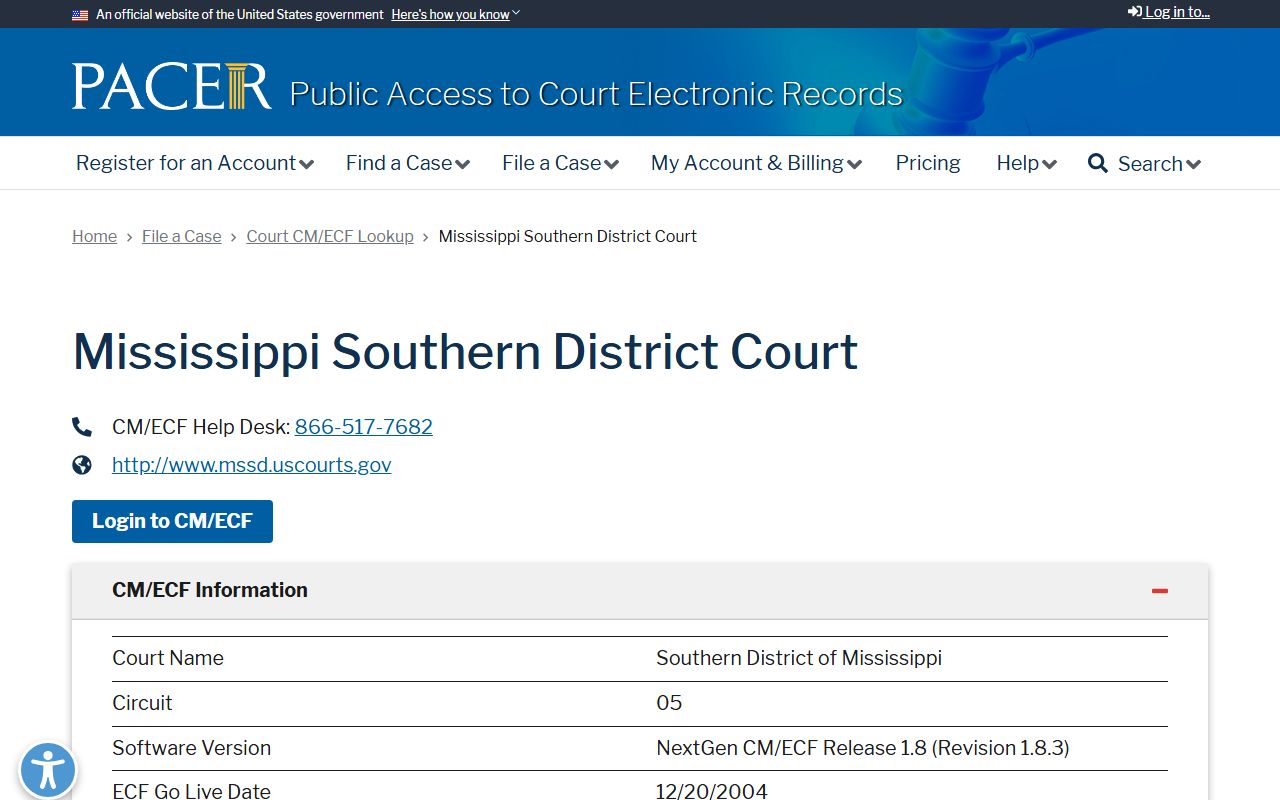
That federal portal matters when a Jasper County matter is charged as a U.S. offense rather than a state felony. For a wider look at every court level in the county, the general court records page maps the full system.
What Jasper County Criminal Records Show
A criminal case file is built from labeled fields, and each one answers a different question. Together they describe who was charged, what court holds the case, what the state alleged, and how the matter ended. The Thirteenth Circuit system exposes the court name, judicial district, case number, party names, filing date, case type, docket text, judge, attorneys, and the running list of pleadings and orders. Personal data such as Social Security numbers, dates of birth, and minor children's names must be redacted from filings, so the public view leaves those out. The table maps the core fields you will read in a Jasper County criminal file.
| Field | What It Shows |
|---|---|
| Case Number | The unique court identifier tied to the judicial district and filing year. |
| Court & District | Whether the file sits in the First District at Paulding or the Second at Bay Springs. |
| Defendant | The person formally charged, listed by name as the responding party. |
| Charges | The offenses as filed in the indictment or charging document, with statute citations. |
| Plea | The defendant's formal answer, such as guilty, not guilty, or no contest. |
| Disposition | The outcome of each charge, including dismissal, acquittal, or conviction. |
| Sentence | Any prison term, probation, fine, restitution, or supervision ordered after a conviction. |
Jasper County Case Status Flags
The Thirteenth Circuit case-management system tags files with short status codes called flags. They give a fast read on where a case stands without opening every order. The list below defines the flags you are most likely to meet in a Jasper County criminal file. Each one points to a stage or event in the case life.
- Bench Warrant Issued
- A judge has ordered an arrest, often after a missed court date.
- Capias Pending
- An arrest or appearance writ is open and awaiting service.
- Bound Over
- A lower court has sent a felony matter up to Circuit Court.
- Plea Pending
- A plea is expected but not yet entered on the record.
- Nolle Pros Pending
- The prosecutor is moving to drop or not pursue a charge.
- Pretrial Intervention Pending
- A diversion track that may end in dismissal after successful completion.
- Probation Violation Pending
- An alleged breach of probation terms is before the court.
- Expunged
- A court order has removed the record from ordinary public view.
Charges vs. Convictions
Being charged is not the same as being convicted. A criminal court record can show charges that were later dropped, dismissed, or ended in an acquittal. A charge is an accusation that rests on probable cause. A conviction is a finding of guilt that rests on proof beyond a reasonable doubt, reached by a plea or a verdict. Both can appear in the public file, so a careful reader checks the disposition before drawing any conclusion about guilt.
| Charge | Conviction | |
|---|---|---|
| Stage | Accusation | Verdict or plea |
| Burden of Proof | Probable cause | Beyond reasonable doubt |
| What It Means | The state says an offense occurred | The court has found guilt |
| Public Record | Yes | Yes |
Reading Jasper County Dispositions and Sentences
The disposition is the heart of any criminal file, because it states how each charge ended. A case may close on one charge while another stays open, so read the disposition charge by charge rather than as one label. Diversion outcomes, such as pretrial intervention, can leave a charge pending until a program is finished, then resolve in a dismissal. Common dispositions in Jasper County records include the following.
- Guilty by plea or by jury verdict.
- Not guilty, recorded as an acquittal.
- Dismissed or resolved by nolle prosequi.
- Nolo contendere, a no-contest plea.
- Diversion or pretrial intervention, which may later end in dismissal.
A sentence follows a conviction and spells out what the court imposed. It can list a prison term with the Department of Corrections, probation under supervision, fines, court costs, restitution to victims, or a suspended portion held over the defendant. Watch for split terms, where part of a sentence is served and part is suspended, and for any flag showing a later probation revocation.
Public Access to Jasper County Criminal Records
Mississippi treats most court files as open to any person. The Public Records Act supports inspection unless a statute exempts the material, and criminal case files generally qualify as public once charges are filed. Online access runs through PAMEC, the public-access piece of the state court system, which gives read-only viewing to registered users. The courthouse counter remains the fallback when an online record is missing, blocked, or restricted, and copy fees apply for reproduction during regular business hours.
Key Statutes:
Miss. Code Ann. Title 25, Chapter 61 - public records are open for inspection by any person unless a statute exempts them.
MEC public access rules - PAMEC gives read-only remote viewing, while courthouse access stays open during business hours unless a court limits it.
Sealed vs. Expunged Records
Sealing and expunction both pull a record out of public reach, but they are not the same. A sealed file still exists and can be reached with limited authority or a court order. An expunged file is treated as if it never happened, and the public court view should no longer return it in ordinary search. Expunction in Mississippi is court-driven, so a person normally files in the court where the charge or conviction occurred. The core statute is being amended during 2026, so verify the current text before relying on any waiting period.
| Sealed | Expunged | |
|---|---|---|
| Visibility | Hidden from the public | Treated as never existed |
| Law Enforcement | Limited access | Very limited access |
| Eligibility | Set by court order and case type | Governed by Miss. Code Ann. § 99-19-71, verify current text |
The 2026 amendment to the expunction statute is moving through the Legislature, and its text controls who qualifies and when.
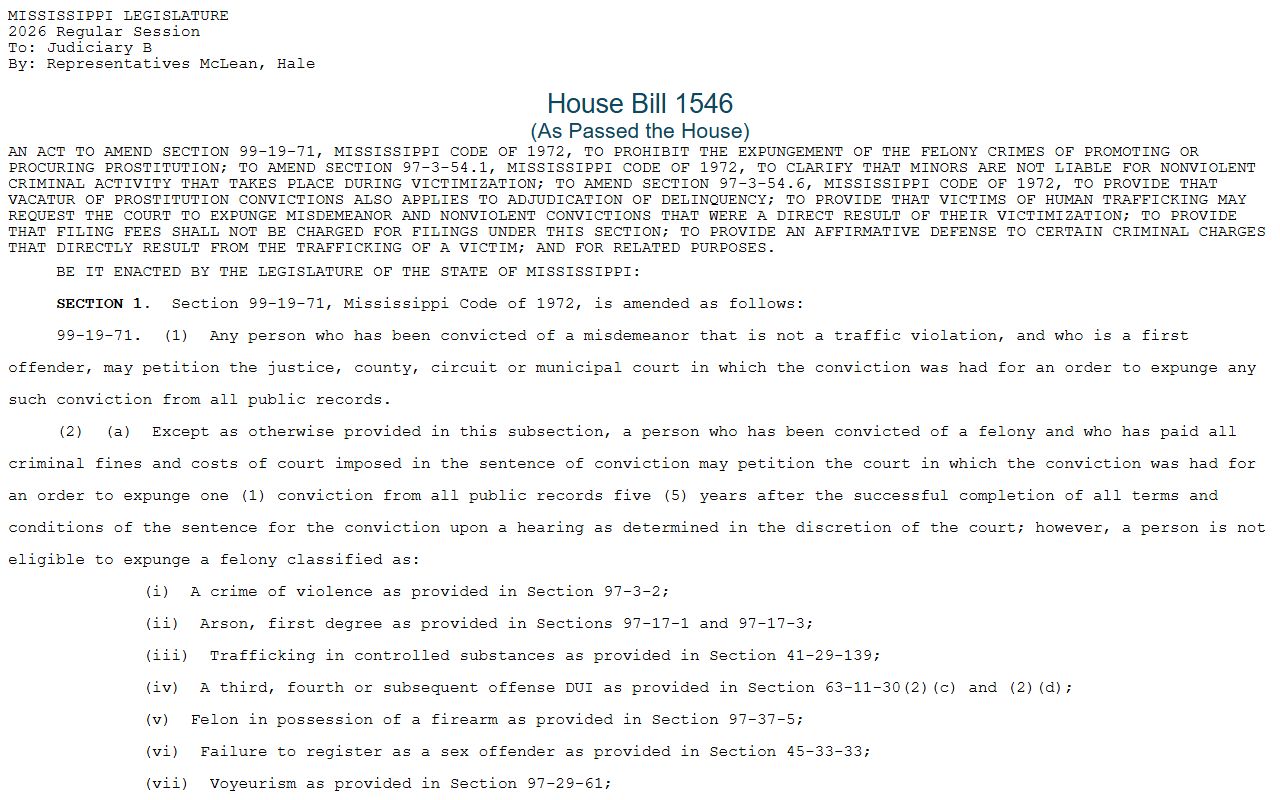
Because the 2026 expunction bill text can change eligibility, read the current version before filing any petition in Jasper County.
Background Check Considerations
Reading a criminal file for personal curiosity is different from running a formal background check. A regulated background check for employment, housing, or credit must follow the federal Fair Credit Reporting Act and use a licensed consumer reporting agency. A casual lookup through PAMEC or the clerk counter carries no such status. The two should never be confused, because a public docket can hold dismissed or expunged matters that an FCRA report may not lawfully use.
Important: This website is not a consumer reporting agency under the FCRA, and its information may not be used for credit, employment, tenant, or insurance decisions.
Restricted Jasper County Criminal Records
Not every criminal-related file is open. Youth Court matters, which cover juvenile offenses along with abuse and neglect, are confidential and need party status, counsel status, or a court order to view. Sealed and expunged cases drop out of public search by design. Active investigations and some warrant records may be withheld while a matter stays open, and the jail roster is a custody log rather than the court file, so a roster check answers who is in custody today, not how a case ended.
Youth Court in Jasper County runs through referee judges tied to the Chancery and family system, and the state describes these records as restricted rather than public lookup material.
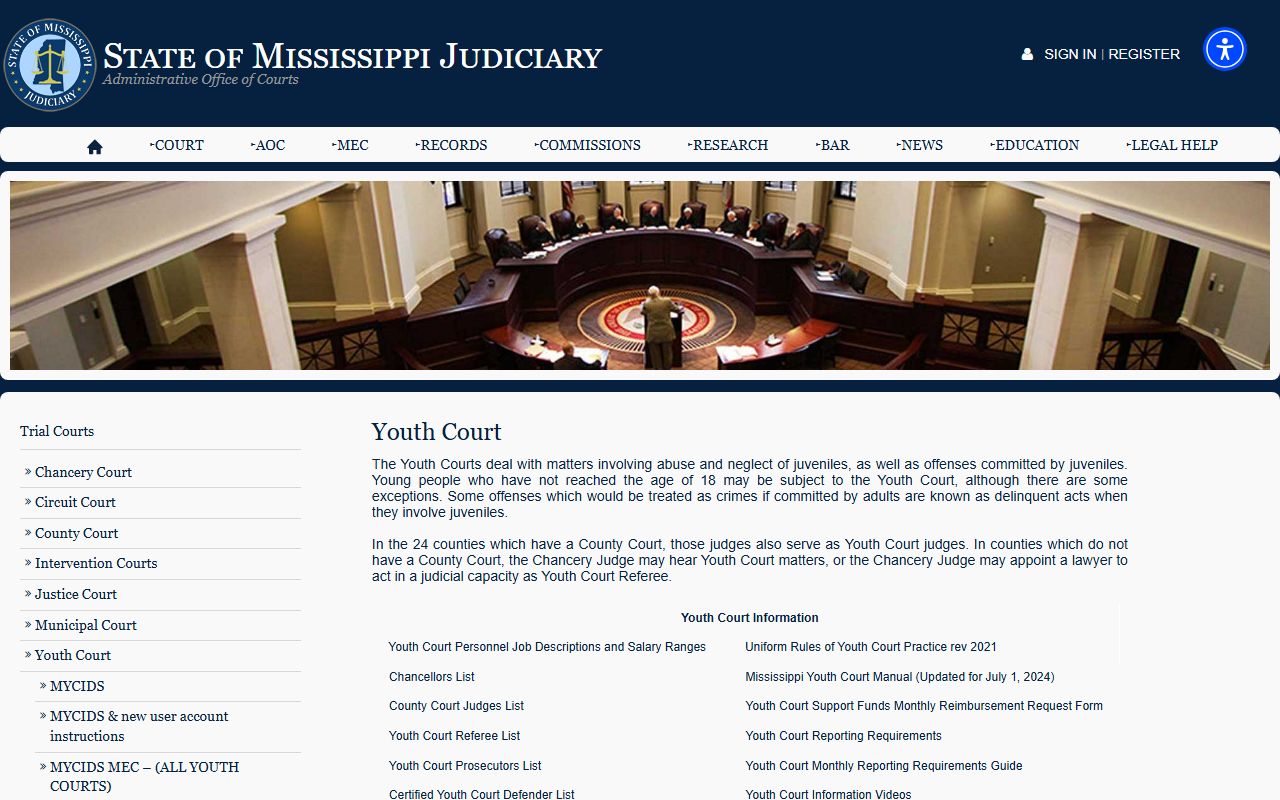
The Mississippi Youth Court overview explains why juvenile files stay closed and who may request access through the court.