
How to Search Jasper County Court Records
Jasper County court-record searching is not built on a single county website. The official online path for Circuit and Chancery case files is Mississippi Electronic Courts, known as MEC, and its public-access piece, PAMEC. The Thirteenth Circuit MEC pages cover Jasper County Circuit Court in both judicial districts. The Second Chancery District MEC pages cover Jasper County Chancery Court in both districts. Public users who only need to view filed documents and case data use a PAMEC login. Attorneys use MEC filing credentials. If you do not yet have a login, the system points you to register online first.
Before you start, gather a few basics. You want full party names, an approximate filing year, the case type, and the case number if you have it. You also need to know the court level. Felony and large civil matters sit in Circuit Court. Divorce, estates, guardianships, and land disputes sit in Chancery Court. Have a payment method ready, because viewing copies through PAMEC carries a per-page charge.
The Mississippi Judiciary keeps a central Mississippi Electronic Courts landing page with helpdesk and login links.
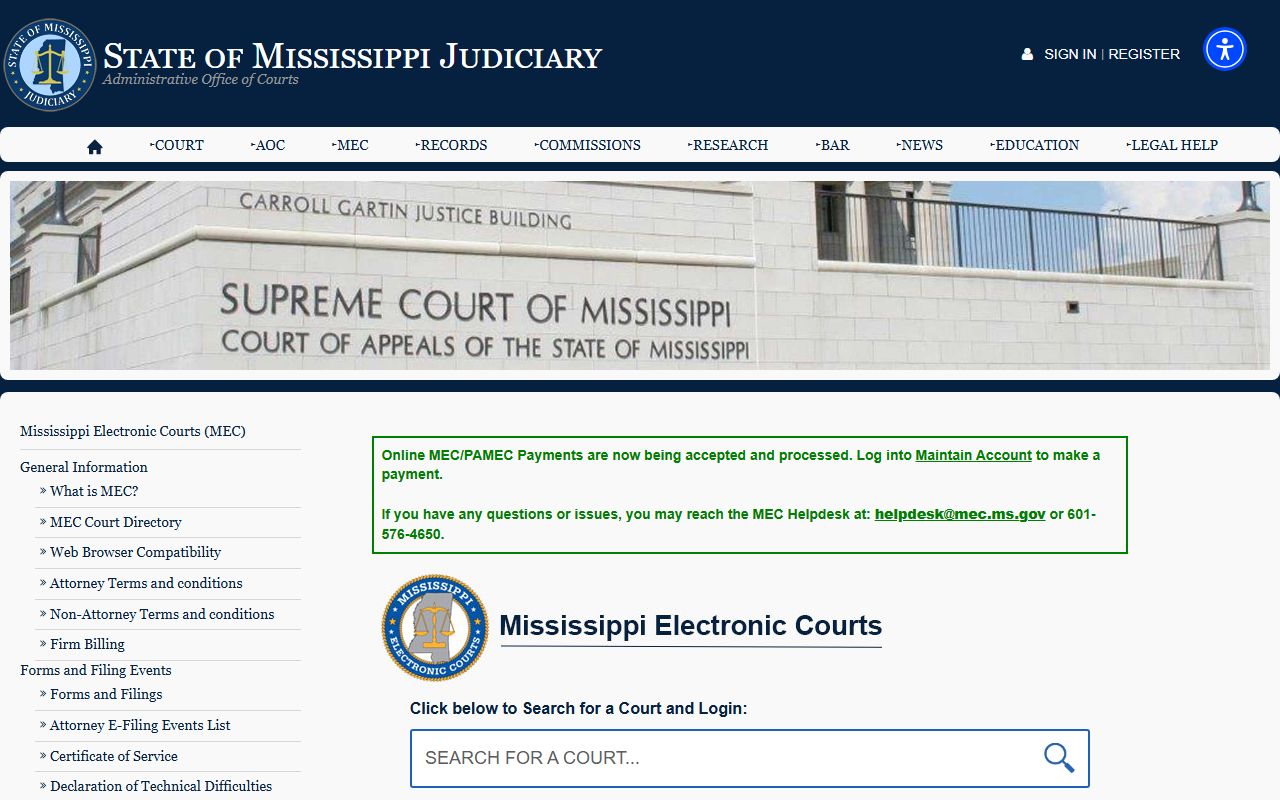
That landing page sends Jasper County users into the login gate for both the Circuit and Chancery systems that hold local case data. Follow the ordered steps below to move from the right court level to the correct online or counter channel.
- Identify the court level first. Felony and major civil cases usually begin in Circuit Court. Divorce, estate, guardianship, conservatorship, and land matters begin in Chancery Court. Traffic and minor criminal matters may sit in Justice Court or a city court.
- Identify the judicial district. Jasper County runs a Paulding office and a Bay Springs office. Match the case, land record, or marriage matter to the district when you can.
- For Circuit or Chancery files online, open the relevant MEC court-information page and then the MEC or PAMEC system. Register for a public PAMEC account if you lack credentials.
- If PAMEC blocks the record, a login is missing, or the category is restricted, call or visit the correct clerk. The online system does not replace the public counter.
- For paper-only or older material, request copies in person or by mail from the Circuit or Chancery Clerk. Give full party names, the year, the case type, and note whether you need certified copies.
Jasper County Court Records Search Fields
The MEC and PAMEC entry pages put a short login form between the public and the case files. Search-field details inside the case-search screens are not visible without a registered account, so the table below maps the fields on the access gate itself. Public users without a login click the registration link to set up an account before any case search opens. The login form is the same gateway for Jasper County Circuit and Chancery records.
| Field Label | Type | Required | Notes / Format |
|---|---|---|---|
| Authentication Login | Text | Yes | Username shown on MEC and PAMEC login pages |
| Password | Password | Yes | Paired with the login on the same screen |
| Client Code | Text | Optional | Useful for firms or internal billing |
| Forgot Password | Link | Optional | Login recovery option |
| Forgot Username | Link | Optional | Login recovery option |
| Register Online | Link | Yes for new users | Sends you to the PAMEC public registration site |
New Jasper County users set up access through the PAMEC public registration site.
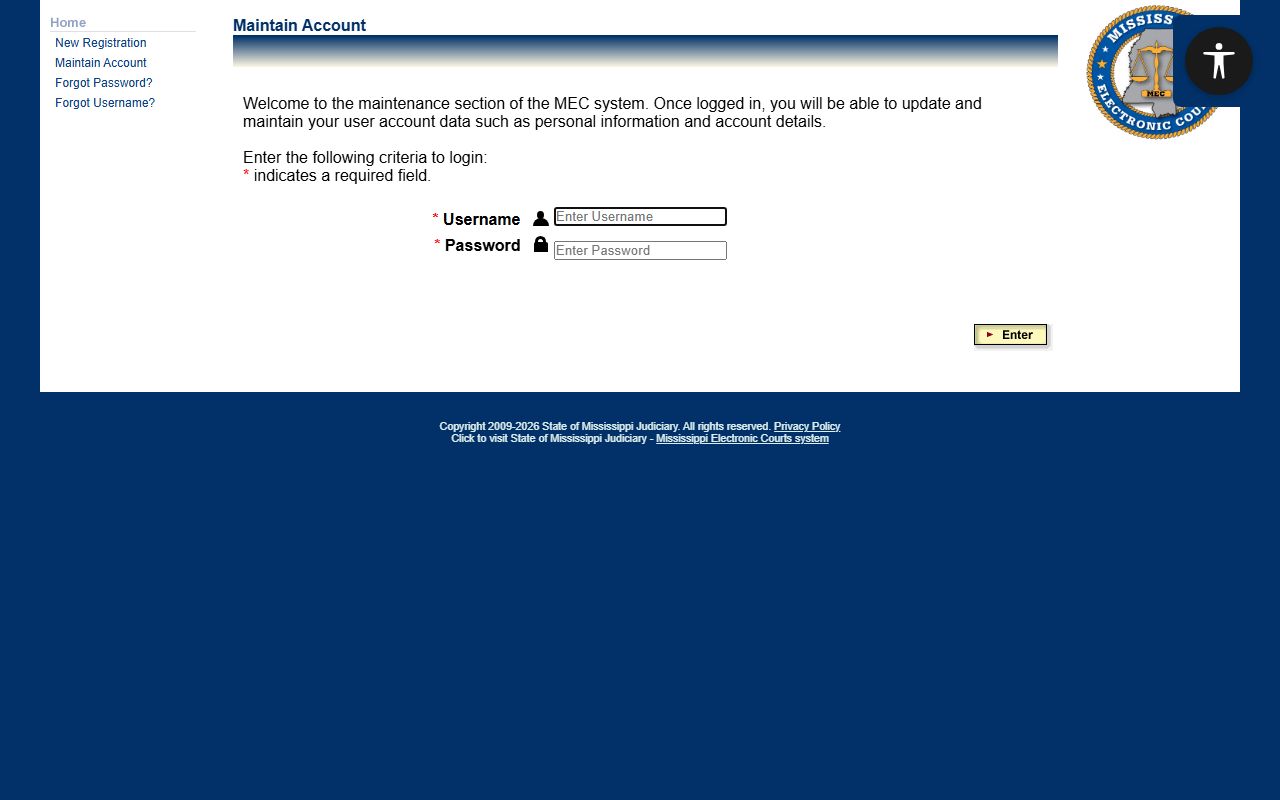
Registration creates the read-only public account that lets you view docket entries and filed documents from courts that have moved onto the system. Without that account, the login gate simply stops you at the door.
Types of Jasper County Court Records
Jasper County court files split by the court that creates them. Circuit Court produces felony criminal files and larger civil suits. Chancery Court produces divorce, estate, guardianship, and land files. Justice Court produces small civil claims, misdemeanors, citations issued outside city limits, and process papers. City courts handle municipal ordinance and traffic matters. The same county website lists conflicting dollar limits for Circuit civil cases, so do not treat any single threshold as final. Confirm the limit with the Circuit Clerk before you rely on it. The Circuit Clerk office is the hub for Circuit filings, judgments, and marriage licenses.
Each venue keeps its own record set. The list below sketches the main categories a Jasper County search may turn up.
- Civil Circuit Court files, with complaints, answers, motions, orders, judgments, and appeal notices.
- Criminal Circuit Court files, with indictments, arraignment entries, bond orders, pleas, verdicts, and sentencing.
- Chancery and family files, including divorce, custody, estates, guardianships, and land or title matters.
- Justice Court files, covering small debt claims, misdemeanors, citations, subpoenas, and warrants.
- Traffic matters, split between Justice Court, city courts, and the separate state driver record.
- Marriage records, issued and held by the Circuit Clerk.
Mississippi completed its statewide move to electronic filing in 2025, a milestone the Judiciary announced in an official e-filing completion news release.
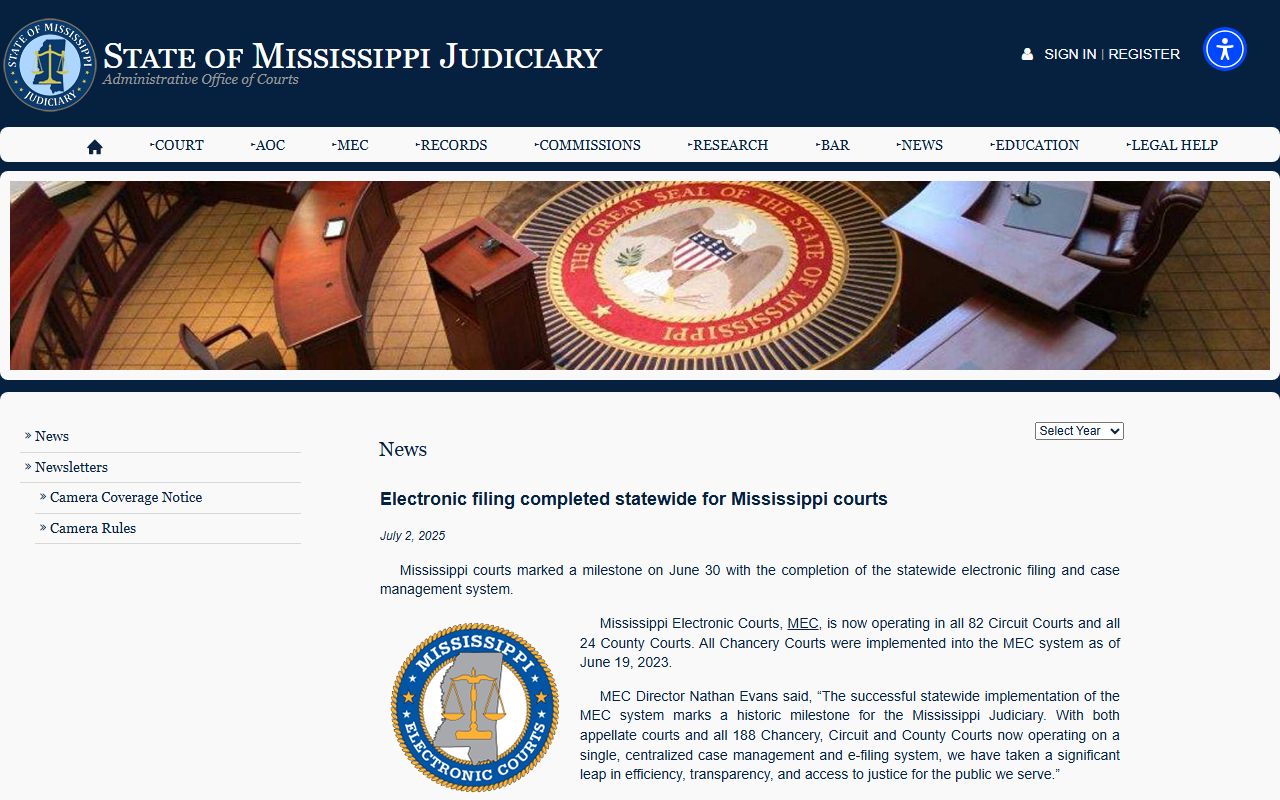
That rollout means Jasper County Circuit and Chancery filings now flow through the same digital backbone the public taps for online viewing. The Circuit system went live in December 2016, and the Chancery system followed in July 2019.
What Jasper County Court Records Show
A Jasper County court file carries the running story of a case. The court-information record for the Thirteenth Circuit, inspected through the public MEC page, exposes the local court locations, system data, and a rich set of status flags used on dockets. The field inventory below reflects the data points a Circuit or Chancery file commonly holds once you reach the case screen. Personal identifiers such as Social Security numbers, dates of birth, minor children's names, and home addresses are redacted under the system's rules.
| Field | What It Shows |
|---|---|
| Court Name | The trial court and division holding the case, such as Thirteenth Circuit or Second Chancery |
| Judicial District | Paulding First District or Bay Springs Second District |
| Case Number | The unique docket number assigned at filing |
| Party Names | Plaintiff, defendant, petitioner, or respondent and their counsel |
| Filing Date | When the action was opened with the clerk |
| Case Type | Civil, criminal, domestic, probate, or appeal category |
| Docket Text | Entries for pleadings, motions, orders, and hearings |
| Flag / Status | Codes like Trial Pending, Bound Over, Probation, Sealed, or Expunged |
| Judge | The judge or referee assigned to the matter |
| Disposition | Final judgment, plea result, dismissal, or sentencing outcome |
| Financial Entries | Bonds, fees, restitution, and partial-payment notes |
The Judiciary describes the public, attorney, and court-staff views on its MEC general information page.
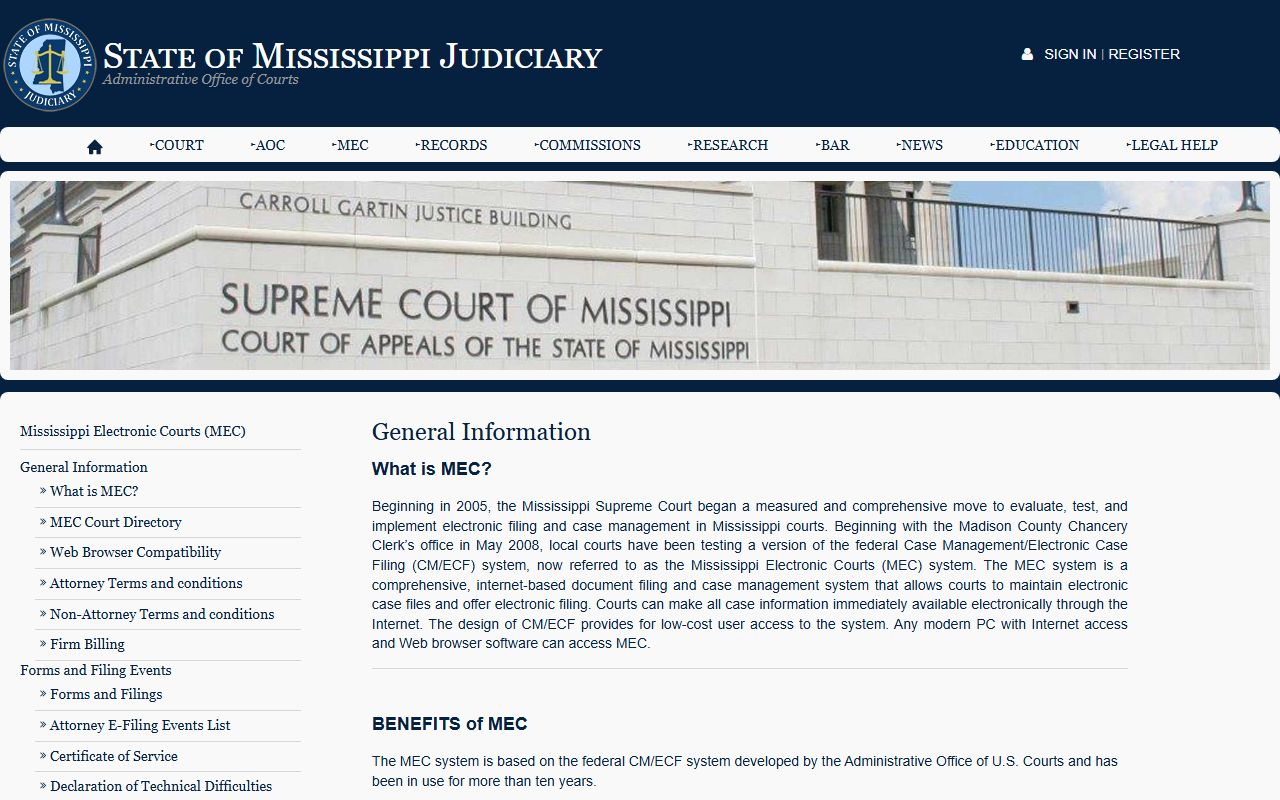
That overview confirms that public users get read-only docket and document access, while filing rights stay with attorneys and court staff. The flag codes on each docket double as a quick glossary for where a case stands. Live docket-call settings and hearing dates appear on the court docket schedule for the Thirteenth Circuit.
Public Access Framework for Jasper County Records
Public access in Jasper County rests on the Mississippi Public Records Act, found at Title 25, Chapter 61 of the state code. The law treats most public records as open for inspection by any person unless a statute exempts them. The Mississippi Ethics Commission public-records page hosts the act and explains how the rules apply. A records request goes first to the office that holds the file. For court case files, that office is the court clerk, not the Board of Supervisors or the sheriff.
The online system adds its own access layer. Under the MEC procedures, public remote access through PAMEC is read-only unless a user holds filing rights. The public can also view files for free at the courthouse or clerk's office during regular business hours, though copy fees apply when you ask for reproductions. A registration fee and a per-page viewing charge have been reported for the public system, so confirm the current terms before you rely on a figure.
The non-attorney terms spell out that public access is a registered-account service, as shown on the PAMEC non-attorney terms page.
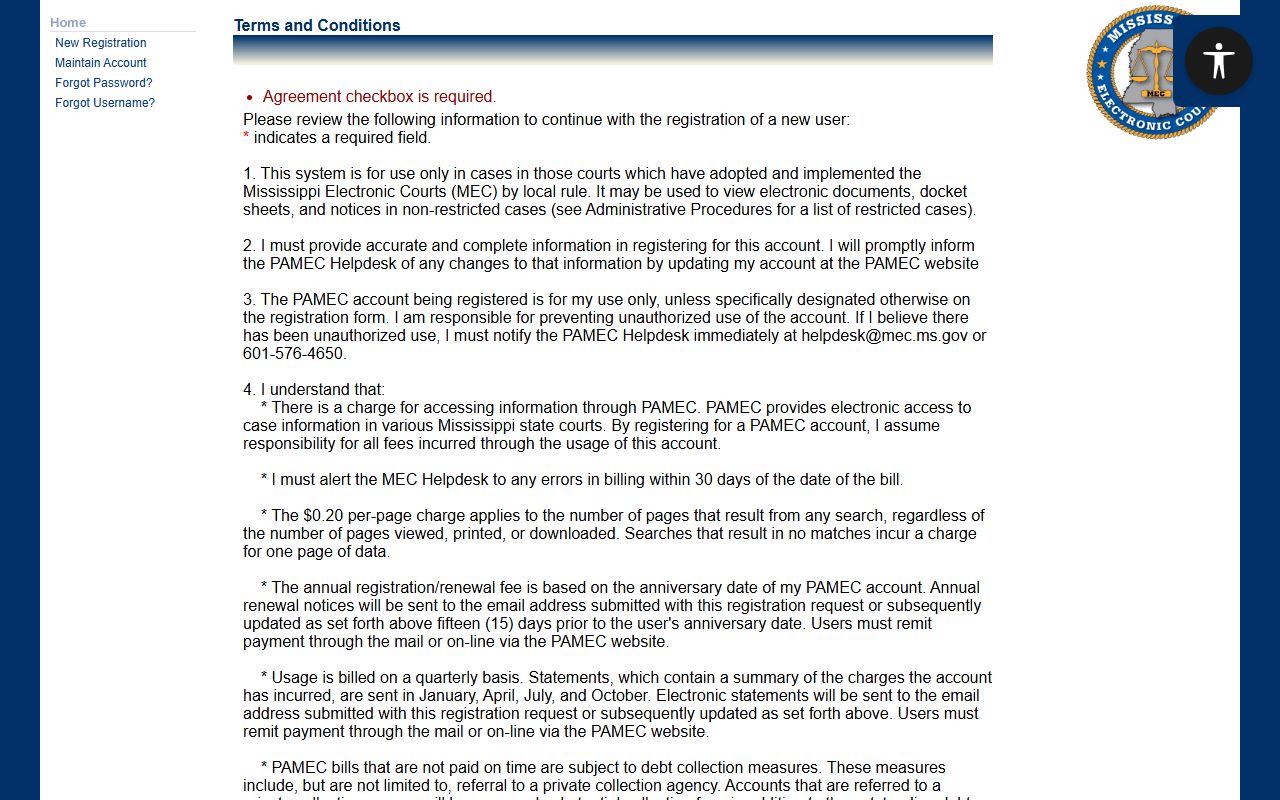
Those terms make clear that public users agree to view-only conditions before any Jasper County docket opens. The act supports access, but it does not unlock sealed, juvenile, expunged, or otherwise restricted files.
Note: The Public Records Act opens most files to any person, yet it does not make confidential, sealed, juvenile, or expunged court material public.
Records That Are Sealed or Confidential in Jasper County
Several Jasper County record categories sit outside ordinary public search. Youth Court matters involving abuse, neglect, or juvenile offenses are not normal lookup records, and access usually requires party status, counsel status, or a court order. Remote public access is also closed for child custody and visitation, child support, divorce, termination of parental rights, adoption, birth-certificate correction, conservatorship, guardianship, minor's settlement, and protection from domestic abuse cases. The Chancery Clerk may release permitted parts of those files, but full online download is not the path. Sealed and expunged files carry their own flags, and ordinary users should not expect to pull them up online.
Petitioning to seal, expunge, or view a restricted file is court-driven. The person seeking relief normally files in the court where the conviction, charge, or arrest occurred, which in Jasper County may be Justice Court, a city court, or Circuit Court. Section 99-19-71 of the state code is the core statute for many criminal expunction questions, but the Legislature has been amending it during 2026, so verify the current text before relying on any waiting period. The practical steps run in order: identify the court of record, obtain the case number and disposition, confirm eligibility, file the petition packet with the clerk, pay any fee or request a waiver, serve the required agencies and prosecutor, attend a hearing if one is set, and deliver the signed order to the repositories the court names. Once entered and processed, the file should drop out of ordinary public search.
In-Person and Other Request Channels
When the online system stalls or the file is paper-only, the clerk counter is the fallback. Match the request to the correct judicial district before you drive. First District records live at the Paulding courthouse. Second District records live at the Bay Springs courthouse. Bring a government photo ID, the party names, the year, and the case number if you have it, and state whether you need certified copies. Phone first to confirm copy fees, since plain and certified copy charges are set by the office. By mail, send the request to the district P.O. box with full details and a return address. For records the clerk does not hold, such as sheriff booking data or state driver history, route the request to the agency with custody under the Public Records Act.
Circuit Clerk, Second Judicial District
P.O. Box 447
Bay Springs, MS 39422
601-764-2245
Mon-Fri 8 a.m. to 5 p.m.
Circuit Clerk, First Judicial District
P.O. Box 58
Paulding, MS 39348
601-727-4941
Mon-Fri 8 a.m. to 5 p.m.
Chancery Clerk, Second Judicial District
27 West 8th Avenue, P.O. Box 1047
Bay Springs, MS 39422
601-764-3368
Mon-Fri 8 a.m. to 5 p.m.
Note: Two courthouses serve two districts, so confirm whether the file belongs in Paulding or Bay Springs before you mail or visit.